Quiet roads: finding a low-traffic route to train on
Traffic is one of the reasons riders give for doing their intervals on the trainer. Busy roads make a ride tense, cut intervals short and leave less attention for the effort. Most areas have quieter roads than the ones people ride out of habit. This guide covers how to find them and how to use them for training.
What makes a road busy
Traffic follows road class. Main roads link towns and carry most of the through traffic. Secondary roads are mixed. Minor roads, farm lanes and roads that don’t lead anywhere useful for a car are usually quiet. Built-up areas add junctions, parked cars and turning traffic, so the same road is busier through a village than between two.
A road can look quiet on a map and still carry commuter traffic as a shortcut. Riding it once, or asking local riders, settles it.
Where to find quiet roads
Look for the small roads that run alongside the main ones: the old road next to a bypass, the valley road on the other bank, lanes between farms. Bike paths along rivers and canals are traffic-free but often busy with walkers, which suits easy riding better than intervals. Club routes and popular segments show where local riders train, which is usually a good sign.
When you ride matters
The same road carries very different traffic at 7 am on a Sunday and at 5 pm on a weekday. Early mornings and weekends are quietest on most country roads. Roads to leisure spots get busier on sunny weekend afternoons, and roads near industrial areas are quiet at weekends.
Quiet roads and training
Easy rides benefit from quiet roads because you can relax. Hard efforts need them more: at threshold or above, your attention goes to the effort and you react later. Keep intervals for the quietest stretches, ride a new road once at an easy pace first, and keep junctions and villages for the recoveries.
Quiet roads are often narrower, rougher and more rolling than main roads. That’s fine for endurance riding, but a broken surface takes more power at the same speed, and a rolling road can make a steady effort harder to hold.
The Quiet roads profile
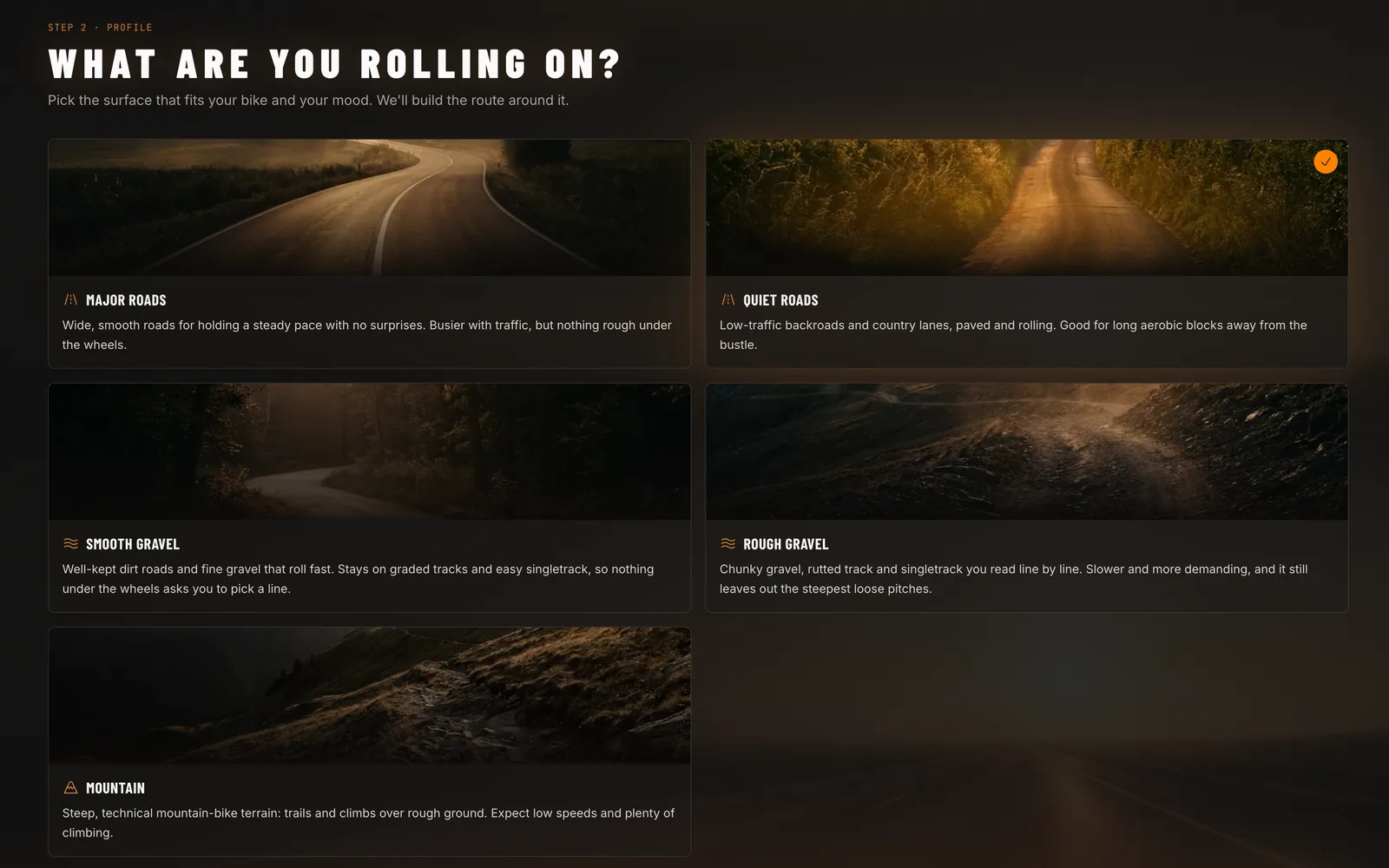
In Gritmaps, the Quiet roads profile keeps the route on low-traffic backroads and country lanes, paved and rolling. On every profile, busy roads, estimated from road class and built-up density, lower the route’s score, and intersections, traffic lights and dense urban sections are penalised inside hard efforts. The route is also scored on how closely the predicted power, with the wind forecast for your start time, follows your workout, and on surface.
Pick a workout from the library, an Instant workout or one from intervals.icu or TrainingPeaks, choose Quiet roads, set your start and when you ride, and Gritmaps returns the best-scoring routes. Generating routes is free. Create your free account and plan a ride away from the traffic.